Blog Archives

Navigating the Revitalization and Renewal of the Church

The church, is always in the midst of a storm… but safe in Him
Thoughts which drive me to Jesus, and to His Cross
“With antiphonal response they sang, praising and glorifying the LORD: “For he is good; his loyal love toward Israel is forever.” All the people gave a loud shout as they praised the LORD when the temple of the LORD was established. Many of the priests, the Levites, and the leaders—older people who had seen with their own eyes the former temple while it was still established—were weeping loudly, and many others raised their voice in a joyous shout. People were unable to tell the difference between the sound of joyous shouting and the sound of the people’s weeping, for the people were shouting so loudly that the sound was heard a long way off.” (Ezra 3:11–13, NET)
Falsely are our churches accused of abolishing the Mass; for the Mass is retained among us, and celebrated with the highest reverence. Nearly all the usual ceremonies are also preserved, save that the parts sung in Latin are interspersed here and there with German hymns, which have been added to teach the people. For ceremonies are needed to this end alone that the unlearned be taught [what they need to know of Christ].
In promoting development, the Christian faith does not rely on privilege or positions of power, nor even on the merits of Christians … but only on Christ, to whom every authentic vocation to integral human development must be directed. The Gospel is fundamental for development, because in the Gospel, Christ, “in the very revelation of the mystery of the Father and of his love, fully reveals humanity to itself.”
I have been thinking about my “career” as a pastor recently. It was 27 years ago this month I went from being a part-time to a full-time pastor. It’s been 23 years in August that I moved from being a non-denom pastor to becoming a Lutheran one, and last week-it was seventeen years since I received the call to become pastor in this place.
In that time I have seen a lot of changes in the world, the church at large and in my Lutheran group. Some of them quite good, some of them heartbreaking. I know the joy of Ezra’s people, as they saw God’s promises re-established for them, and I also understand the heartbreak of those who remember the past and its glories.
I am the one who wails over the losses, and yet I am the one who screams for joy at the renewal I see. A foot in both worlds, a foot which wants to deny the existence of the other….
I have tried to help both sides realize the other exists, not because i want to create a form of toleration, for that is worthless, and to be honest, vain.
In my devotional reading this morning, I came back to the answer–provided by the Lutheran Confessions and Pope Benedict. The answer isn’t to dwell in the past, failing to recognize its failure. It isn’t about just rejoicing in the victories of the moment–ignoring its shortcomings.
The answer is simply this – living in Christ, and revealing Him to those who so desperately need Him. To revoice in the enlightenment the Spirit provides in them–the relationship that is reformed, renewed, reborn! To sound more academic — to rejoice in the delivery and reception of grace, rather than comment on the color, texture and design. To dance with God and the angels over new life.
To be revitalized, not just an interested observer of it.
Then the church weeps and rejoices together, for God is good, and His mercy is forever!
Melancthon, P. (2006). The Augsburg Confession (1530). WORDsearch.
De Gaál, E. (2018). O Lord, I Seek Your Countenance: Explorations and Discoveries in Pope Benedict XVI’s Theology (M. Levering, Ed.; p. 197). Emmaus Academic.

“Take off your shoes!” –Hope for the Dead/Dying Church

Thoughts to draw us closer to Jesus….
When Joshua was near the town of Jericho, he looked up and saw a man standing in front of him with sword in hand. Joshua went up to him and demanded, “Are you friend or foe?” 14 “Neither one,” he replied. “I am the commander of the LORD’s army.” At this, Joshua fell with his face to the ground in reverence. “I am at your command,” Joshua said. “What do you want your servant to do?” 15 The commander of the LORD’s army replied, “Take off your sandals, for the place where you are standing is holy.” And Joshua did as he was told. Joshua 5:13-15 NLT
So it is in the Church of Christ. It is literally true that some churches are dead. The Holy Spirit has gone out of them and all you have left are “the remains.” You have the potential of the church but you do not have the church, just as you have in a dead man the potential of a living man but you do not have a living man. He can’t talk, he can’t taste, he can’t touch, he can’t feel, he can’t smell, he can’t see, he can’t hear—because he is dead! The soul has gone out of the man, and when the Holy Spirit is not present in the Church, you have to get along after the methods of business or politics or psychology or human effort.
In this petition you will notice that God bids us to pray against ourselves. In that way he teaches us that we have no greater enemy than ourself. You see, our will is the most formidable element in us, and against it we must pray, “O Father, do not let me get to the point where my will is done. Break my will; resist it. No matter what happens let my life be governed not by my will, but by yours. As no one’s own will prevails in heaven so may it also be here on earth.” Such a petition or its fulfilment is indeed very painful to our human nature, for our own will is the greatest and most deep rooted evil in us, and nothing is dearer to us than our own will.
Therefore, we are asking for nothing else in this petition than the cross, torment, adversity, and sufferings of every kind, since these serve the destruction of our will. If these self-willed people really thought about this and noted that they are praying against their own will, they would turn against this petition or even be frightened by it.
Over the years, I have worked with several churches that I was told were dead, or would soon be dead. My first church was one of these, and yet it is now nearly 20 times more than it was when I got there 25 years ago. (Most of that growth after me…. to be honest) The desk I sit in presently, one expert said would be abandoned 8 years ago…as the church was impossible to save. We are still here, in some ways struggling… yet more alive than ever.
I didn’t think either was, for the Holy Spirit was there. There was a hunger to hear about God, His compassion, mercy and forgiveness.
I’ve also seen much larger churches where that hunger was non-existent, and Tozer would say they are dead, even though they have hundreds or thousands showing up on a Sunday. They have the book of the month club which shows them how to “do” church right. Or they adapt the latest thing from the mega chruch in the next city, hoping to replicate what is happening there. Their faith ends up to be more in the program, than in the person of Christ. And so year after year, the “hope” for the future changes. Their guide book changes, and they get further and further from trusting in Jesus.
Here is where Luther’s discussion of the phrase, “Thy will be done” is so relevant. Whether a chruch is 12 or 50 or 5000, will it seek the Father’s will – knowing that their own will must die at the cross? Will they embrace the suffering, the sacrifice, the death of their preferences, in order to see what God is calling them to be? That is a dangerous prayer! If we realized what it could cost us, as Luther pointed out, people would run rather than pray it…
Unless they realize how desperate they are…. and that God is their only hope. Individually – and as a congregation.
As Joshua and Israel met Jesus as they crossed the Jordan, we see what all church leaders and their churches need to realize. God doesn’t have our back because He is impressed with His partners in ministry. God isn’t impressed with our plans for His church, the systems and visions we “borrow” may not work in our setting, especially if we put our hope in the system or vision, and not in the Lord.
He is the Lord, He is God. He is the one that gives each church its mission and vision in each community. It is His presence that turns the sancturary and campus into Holy Ground.
For He has come to dwell with us….and that is the other reason to take off your shoes… you are home. When our will is crucified, when our plans and desires are nailed to the cross… we have not only died, we are risen in Him, together.
Take your shoes off, make yourself at home in His presence, and let Him lead His people….
Tozer, A. W. 2015. Tozer for the Christian Leader. Chicago: Moody Publishers.
Luther, Martin. 1999. Luther’s Works, Vol. 42: Devotional Writings I. Edited by Jaroslav Jan Pelikan, Hilton C. Oswald, and Helmut T. Lehmann. Vol. 42. Philadelphia: Fortress Press.

Worried about Churches Shrinking and Closing? Consider this threat.
Devotional Thought of the Day:
This is the message from the one who is the Amen—the faithful and true witness, the beginning* of God’s new creation: 15 “I know all the things you do, that you are neither hot nor cold. I wish that you were one or the other! 16 But since you are like lukewarm water, neither hot nor cold, I will spit you out of my mouth! 17 You say, ‘I am rich. I have everything I want. I don’t need a thing!’ And you don’t realize that you are wretched and miserable and poor and blind and naked. Rev. 3:14-17 NLT
437 If one of my fellow men had died to save me from death … God died. And I remain indifferent.
In the last week I have received over 25 emails, texts, or posts referring me to articles that provide hope for the church. Well not, really. They don’t provide hope, they provide an answer to their doomsday prediction – that the church in the next ten or twenty years will be even more in decline than it is today.
They may state we are in a post-Christian, or post Church age. They may say the “nones” are a sign of our ineffective ministry, they may claim society is getting more secular, and even hostile to the church. There are more and more reasons that people come up with for churches in decline. They then give advice to counter the threat, many even coming to the theory that we need to “save what we can”.
But those answers are, for the most part, systematic, programmatic, and structural. They make the vision of the church a response to the perceived threat. They make what drives the church an almost militant response to the outside world, and a militant response that seeks to regroup, even while it retreats.
And in the process forgets God, and remains indifferent to His role in His church, in His Kingdom. We have become like Laodicea, trying to work in our strength, and our riches, when most churches have so little in the bank. When we churches have less in attendance that they are supposed to have on their various boards and committees. We look at the threats so much, we don’t realize how needy we truly are.
If we realize our need, it is the panic button, it is the hiring of consultants, it is the blaming of the lack of support and guidance of our denomination or our brotherhood. We might even think it is the congregation’s leadership, or its pastor that is at fault.
When what we need to do, is realize that we will, in this life, always be in need. We will always struggle, whether our church is 35 or 700, or 22,000. Not because we are failures, not because we are sinners, but because we need and have someone who cares for us, who provides for us, who is with us.
The One we neglect to depend on, even as we sing His praises. The Lord who gives us life, who makes right what is wrong in our lives. We need ot look to HIm, to remember He is present, to remember His love for us. We have to remember and celebrate His death on the cross, to do all the above.
There is our primary answer to the church being in decline – to look to Jesus. The church in Laodicea was told this, in this way,
“Look! I stand at the door and knock. If you hear my voice and open the door, I will come in, and we will share a meal together as friends Rev. 3:20 NLT
These words weren’t written to unbelievers, they were written to the church, to the one Jesus says he wants to spit out, just a few verses before! These words echo Paul’s who says we are to plead with people, “Come Back to Christ!”
He has always been our hope, and the hope for the world! He has the answer to our brokenness, and the trauma in our society. He is the answer for our churches, and whom we aren’t to neglect, in our sermons, in our worship, and in our meetings and planning and vision casting. We need ot remember Him especially in our response to the dwindling numbers in our churches. What will fill them again is not our wisdom or strength, not our structure, or our regrouping what we have. What will fill them in the power of God, the power of God that raised Christ from the dead, and is at work in you, as you walk with Him, as you hear and respond to the Holy Spirit’s direction. As we lead His people to remember Him, as we share in communion, as we walk out with Him into His mission field that is in our lives.
You want to see the church thrive? Realize what God is doing right now, in your life, as He is present. Look around you, see the people that need that very same blessing, and pray for them. As the s Spirit leads, even tell them you are doing so, or ask them if you can pray for them right there, confident that God is there, hearing you both.
If we, the people who are the church, would realize we live in God’s presence, the church will not be empty for long.
The Lord is with you! AMEN!
Escriva, Josemaria. The Way (Kindle Locations 1074-1075). Scepter Publishers. Kindle Edition.

Hope for Believers (and Churches) Burnt Out, or Just Going Through the Motions

Devotional Thought of the Day:
11 God was performing unusual miracles through Paul. 12 Even handkerchiefs and aprons he had used were taken to the sick, and their diseases were driven away, and the evil spirits would go out of them. 13 Some Jews who traveled around and drove out evil spirits also tried to use the name of the Lord Jesus to do this. They said to the evil spirits, “I command you in the name of Jesus, whom Paul preaches.” 14 Seven brothers, who were the sons of a Jewish High Priest named Sceva, were doing this. 15 But the evil spirit said to them, “I know Jesus, and I know about Paul; but you—who are you?” 16 The man who had the evil spirit in him attacked them with such violence that he overpowered them all. They ran away from his house, wounded and with their clothes torn off. 17 All the Jews and Gentiles who lived in Ephesus heard about this; they were all filled with fear, and the name of the Lord Jesus was given greater honor. 18 Many of the believers came, publicly admitting and revealing what they had done. Acts 19:11-18 (TEV)
We need to “go out,” then, in order to test and experience our own anointing and its power and redemptive efficacy into the “outskirts” where there is suffering, bloodshed, blindness longing for sight and prisoners under so many evil masters.
It may sound harsh, but I wonder today if the church is more like the sons of Sceva than like the Apostle Paul.
We go through the motions, we say the right things (at times) we have a good intent, but we lack the faith, the trust in a God we know, to truly minister to others the way we should.
As our efforts don’t result in any significant change, we slowly give up our our outreach. We begin to rely on what others have said or written, rather than express our awe of God directly. We rely on canned presentations, Bible studies written by someone we’ve never met, who doesn’t know the people we study with and/or teach. Prayer and meditation on scripture become things we will do “when we have time”.
And we wonder why we ministry seems a drain, why people don’t realize the blessing that church should be, and why they never are free of their demons.
The more we do, the more the church gets focused internally, the more church politics rips us to shreds, the more churches close their doors, or become places that focus on things other than Jesus, and exploring the incredible dimensions of His love, experiencing what we can never completely explain.
So what is the answer, how do we go from a church of Sceva’s sons, to being an apostolic church.
How do we live out the work of God that became possible when the Holy Spirit called us, when God the Father united us with Jesus, and the same power which raised Him from the dead gave us new life?
I think Pope Francis has the answer, just “go out”, trusting in God enough to go where there is need, to the broken, to those who are blind and suffering, to those who are prisoners . Asking God to make His annointing of our lives known in our lives as we minister to those He puts in front of us.
In order to know that, we have to know He has indeed redeemed us, that we are His people, not because we are so good, but because He has indeed redeemed us. As a pastor, everytime I baptize someone, everytime I give someone the body of Christ, whether the person kneeling at the altar, or the shut-in in their home, or the counselee, whose burdens are lifted as they experience the love of God, the lesson of my own redemption is renewed.
I’ve seen the same thing when parents assist in their child’s baptism, or a sponsor assists in the friend who has come to know God’s love. Our faith is renewed, our dependence on God becomes a great joy, and we realize the world without hope is indeed full of God’s hope.
You see the church may sometimes act like the sons of Sceva, but she isn’t. She may be depressed, and dejected, focused on survival more than mission, but her Lord is with her, strengthening her, giving her life, and urging her to go to the broken in the world, with the assurance she doesn’t do so alone, or on her own power.
We go with the Lord and Giver of Life, empowered by God to do the works He has planned.
This is our call.. this is who we are..
Let’s get back it, walking with our God.
Pope Francis. (2013). A Year with Pope Francis: Daily Reflections from His Writings. (A. Rossa, Ed.) (p. 190). New York; Mahwah, NJ; Toronto, ON: Paulist Press; Novalis.

Your Church Doesn’t Need to Be New to Grow.

The Pantheon, a place once dedicated to worship of idols but reborn to host the worship of God. May our lives tell a similar story as we realize what God does to us in baptism!
Discussion Thought of the Day:
35 Jesus traveled through all the towns and villages, teaching in their synagogues, preaching the Good News about the kingdom, and healing all kinds of diseases and sicknesses. 36 When he saw the crowds, he felt sorry for them because they were hurting and helpless, like sheep without a shepherd. 37 Jesus said to his followers, “There are many people to harvest but only a few workers to help harvest them. 38 Pray to the Lord, who owns the harvest, that he will send more workers to gather his harvest.” Matt 9:35-48 NCV.
Finally, I use these biblical, ancient roots together with insights and practices from Christian history to constitute the foundation for addressing the third issue faced by today’s church: how do you deliver the authentic faith and great wisdom of the past into the new cultural situation of the twenty-first century? The way into the future, I argue, is not an innovative new start for the church; rather, the road to the future runs through the past.
These three matters—roots, connection, and authenticity in a changing world—will help us to maintain continuity with historic Christianity as the church moves forward. I hope what I cull from the past and then translate and adapt into the present will be beneficial to your ministry in the new cultural situation of our time.
858 The first step towards bringing others to the ways of Christ is for them to see you happy and serene, sure in your advance towards God.
In my “different” (some would say twisted) experience in the church, more than once I have come across those who are focused on Church Growth. Originally, church growth theory came from those who saw abundant numbers of conversions on the mission field, and sought to replicate it now that they were “back home”. Now church growth is more affected by statisticians and pollsters, men who observe and make judgments based on what they see, trying to replicate what worked in Texas in Missouri, or what worked in Atlanta in San Diego and Boston.
And the cry today is not to grow the church because that doesn’t work! The idea today is that new starts, new missions, new ideas make the greatest difference, and therefore deserve the greatest talent and the greatest money.
Churches that are forty years old or older and are in decline? Give up on them, let them die the experts say. We’ve consulted with them, we’ve given them surveys and tests, we’ve tried to transform them, and they continue to dwindle. Just give up on them, merge them into bigger churches, sell their properties and use it to start new churches.
There is a greek technical term that describes such advice, taurus skubala! Translated into English, it is easily seen as bullcrap. ( I would type bullshit, but some people might be offended!)
The reason the experts, the consultants fail to transform churches is simple. They aren’t part of the community. They come in on a wing and a prayer, they don’t understand the dynamic of why God put a congregation in that place, ( see the dedication of the Solomon’s Temple for the reason) they try to create a vision where there already was a vision, where there has always been a vision.
And the community struggles to adopt its new identity. It isn’t them, it isn’t authentic, it’s an act. And sooner or later they give it up, and give up the hope that was given to it! They wander around like sheep without a shepherd, simply following what is in front of them, and the shepherds, tired and weary, plod on after them.
But what if the church went back to what it treasured, and from their roots, used what they treasured in Christ and allowed Him to transform them and the world. That was Webber’s plea, with his Ancient-Future Church series. That is what Escriva considered the Opus Dei – the very work of God.
We can shepherd people toward the God we know, that is our call in a new church plant or in a church that is 1700 years old. It is the work of the 80-year-old retired pastor caring for the inner city church that can’t afford a full-time guy; it’s the work of the 26-year-old, fresh from seminary. It is the work of the lay people, who are shepherded by their pastors and priests. For as we do our job, the people know the happiness and serenity that is found in the presence of God. There, in His glorious presence, they find all they need, and it is contagious.
Bring people to Jesus, show them His way, reveal to them His love through word and sacrament. That is how you apply the Bible to their lives. That is how you give them hope, bring them healing, teach them to love as they are loved.
This is what we’ve always done, though somehow we lost that in doing that. It is the reason for the liturgy, for the praises we sing, for our homilies and sermons, for the sacraments we invite people too, knowing that they can and do experience God as they are washed and absolved and fed. As they have always been. Whether they realised it or not, whether we realized it or not.
As we gather tomorrow, may we shepherd the people to Jesus… may they respond as they find healing, peace and joy, and may others come to see Him as well. AMEN!
Webber, Robert E. The Divine Embrace: Recovering the Passionate Spiritual Life. Grand Rapids, MI: Baker Books, 2006. Print. Ancient-Future Series.
Escriva, Josemaria. The Forge (Kindle Locations 3040-3041). Scepter Publishers. Kindle Edition.

Christ-centric life….a good reminder!

Devotional Thought fo the Day:
1 When I came to you, my friends, to preach God’s secret truth, I did not use big words and great learning. 2 For while I was with you, I made up my mind to forget everything except Jesus Christ and especially his death on the cross. 3 So when I came to you, I was weak and trembled all over with fear, 4 and my teaching and message were not delivered with skillful words of human wisdom, but with convincing proof of the power of God’s Spirit. 5 Your faith, then, does not rest on human wisdom but on God’s power.
1 Corinthians 2:1-5 (TEV)
3. Return to God: And Thou, O my God, my Saviour, Thou shalt be from henceforth the sole object of my thoughts: I will no more apply my mind to such as are displeasing to Thee. My memory shall entertain itself all the days of my life with the greatness of thy clemency, so mercifully exercised on me: Thou shalt be the delight of my heart and the sweetness of my whole being. (1)
Twenty years ago, I preached at a small church in the middle of the desert. Two years later, I would become their pastor. And on their letter head was the mission/purpose statement. “Teaching Christ-Centered Living”.
I’ve since come to the conclusion that those phrases, maybe long overlooked, are the key to the church’s misison in that community. That is why they are planted, these phrase, this is a vision God has given those who sacrificed and set down the cornerstone. At my present church, it is the oft repeated phrase, “The Lord is with You!” (and the response to me – “and also with you!” ) You want to revitalize a chruch – you want to see it come to life and share God’s love – discover the reason it was put there in the first place!
So back to Christ-centered living.
We aren’t talking about being religious by rote, or being scholars in Greek and Hebrew Exegesis. We can memorize all the red letters in our Bibles, and still fail to live life centered, focused on Jesus.
SO what does it mean to be centered on Christ in our lives? What does it mean to forget everything bu Christ and His cross?
It means to realize that clemency that deSales speaks of, it means to deligh in the presence of God in our lives, to rejoice in the incarnate, tangible God who speaks and listens. It is to depend on this, and so know a peace that comes from God being our fortress, our sanctuary, our peace.
It means the hope that comes from realizing His comfort, and sharing in His glory, for His glory is the cHesed, the agape, the love, the charity, the compassion of God that draws us to Himself.
To live in awe of that love is Christ-centric living.
And it is our role, as God’s people to use our time, gathered together as the Church, or with a friend over lunch – to teach them what they need to know about Jesus.
My friend, the Lord is with you!
See His love, see His work in your life….. and cry out, “Lord, Have MERCY” or “Hosanna (Save us) ” or “kumbayyah (Be here Lord)” or simply, “thank you!”
(1) Francis de Sales, Saint. An Introduction to the Devout Life. Dublin: M. H. Gill and Son, 1885. Print.

When the Church is the Building….

Discussion thought fo the Day….
27 “But will God really live on earth? Why, even the highest heavens cannot contain you. How much less this Temple I have built! 28 Nevertheless, listen to my prayer and my plea, O LORD my God. Hear the cry and the prayer that your servant is making to you today. 29 May you watch over this Temple night and day, this place where you have said, ‘My name will be there.’ May you always hear the prayers I make toward this place. 30 May you hear the humble and earnest requests from me and your people Israel when we pray toward this place. Yes, hear us from heaven where you live, and when you hear, forgive. 1 Kings 8:27-30 (NLT)
41 “In the future, foreigners who do not belong to your people Israel will hear of you. They will come from distant lands because of your name, 42 for they will hear of your great name and your strong hand and your powerful arm. And when they pray toward this Temple, 43 then hear from heaven where you live, and grant what they ask of you. In this way, all the people of the earth will come to know and fear you, just as your own people Israel do. They, too, will know that this Temple I have built honors your name.
1 Kings 8:41-43 (NLT)
But more than that: we want to see heaven, we seek something greater, for the human soul thirsts for God, for the living God. The places of pilgrimage have marked a kind of geography of faith in our country, that is, they make visible, almost tangible, how our forefathers encountered the living God, how HE did not withdraw after creation or after the time of Jesus Christ, but is always present and works in them so that they were able to experience HIM, follow in his footsteps, and see him in the works HE performed. Yes, HE is there, and HE is still there today. It is from this inner encounter with the Lord that there originated the places and images of pilgrimage in which we, so to speak, can participate in what they saw, in what their faith provided for them. (1)
It has become a mantra among modern Christians, “the church isn’t the building, it is the people!”
And as this has become more common, we see the church becoming more disposable, we are willing to let them fade into ruin, we are willing to sell them off and let them become restaurants, or antique shops, or be torn down to make way for homes or strip malls.
Let me be clear, I am not talking about Gothic cathedrals; the Church might be a store front, or a modular building, or an old wooden frame building out in the country. Nor am I talking about a form of worship – either that modified from ancient forms of liturgy, or free-form prayer and study that is equally ancient.
But these places are the church.
Because they are the places, like the temple, where God put His Name, they were dedicated to God’s work, to bring honor and glory to His name by becoming a place where the gospel was shared, where people were taught about God’s faithfulness, where people would be baptized and enter into fellowship with others who depend on God. They are the place where that fellowship, God and His people was expressed and celebrated in Communion.
Not just one generation, but generation upon generation. They are the places of pilgrimage we have been given, Pilgrimages that aren’t once i n a lifetime, but daily and weekly..As such, they do what Cardinal Ratzinger wrote about – “they make visible and tangible how our forefathers encountered the living God, how He did not withdraw from them after the time of Jesus Christ, but is ALWAYS present and WORKS in them so that they were able to EXPERIENCE HIM, follow in His footsteps, and see Him int he works He performed. ”
As I watch the church experts these days, there is a new mantra. No longer is it the building that is not the church; the congregations are no longer the church either. More precisely, they find that God doesn’t sustain a church past 25-40 years (they forget the part of the original study talking about rededication – holding on to part that explains their observations) As they have been willing to close the buildings, now we are willing to close down the people.
In doing so, we lose the history, not of this person or that, but of their encountering God on His terms, on His ground, on Holy ground, holy because it was where He put His name, where they built it to honor Him. This is what Cardinal Ratzinger was writing about when he continued,
HE is there, and HE is still there today. It is from this inner encounter with the Lord that there originated the places and images of pilgrimage in which we, so to speak, can participate in what they saw, in what their faith provided for them.
As I talk to people who are broken, there is a need to find something bigger than they are, something that will give us hope, something that will assure us that we can go on, that God is still working with HIs people. That there is something work sacrificing for, not just for our sake, but for our communities. Something that is not just a testimony to this generation, but to generations to come.
These places where God meets His people, where He assures them of His love, where He welcomes those foreign to “religion” to come and pray,t o come and find God’s heart, where they find God revealed to them, can serve in such places, because they always have. They are the gathering places, they are places of peace, because they are places of prayer, and absolution, fellowship, sanctuaries and fortresses where we can find rest and healing.
Sustaining them will take work, sacrifice of time and money. THat’s okay; they took that to build them. It will take a lot of teaching, a lot of sharing why God’s love is important, from scripture and the lives of those who went before. That is okay as well! The greater cost will be found when by closing them, disbanding their people, we send an unintended message of what doesn’t matter to “organized religion,”
They are where we, as a communion meet God. These places, centuries old or decades, large or small, ornate or plain, are where we become part of the church, where we become the church.
Maybe we shouldn’t be so hasty to abandon them, or the people and God that are the reason they exist.
(1) Ratzinger, J. (1992). Co-Workers of the Truth: Meditations for Every Day of the Year. (I. Grassl, Ed., M. F. McCarthy & L. Krauth, Trans.) (p. 165). San Francisco: Ignatius Press.

Are We Afraid of Sanctification? A Cry for the Spirit to Breath Life into the Church
Devotional Thought of the Day:
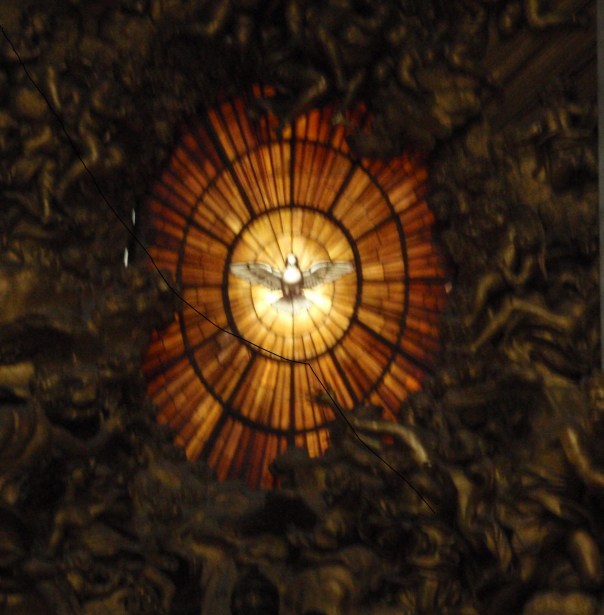 1 The LORD took hold of me, and I was carried away by the Spirit of the LORD to a valley filled with bones. 2 He led me all around among the bones that covered the valley floor. They were scattered everywhere across the ground and were completely dried out. 3 Then he asked me, “Son of man, can these bones become living people again?” “O Sovereign LORD,” I replied, “you alone know the answer to that.” 4 Then he said to me, “Speak a prophetic message to these bones and say, ‘Dry bones, listen to the word of the LORD! 5 This is what the Sovereign LORD says: Look! I am going to put breath into you and make you live again! 6 I will put flesh and muscles on you and cover you with skin. I will put breath into you, and you will come to life. Then you will know that I am the LORD.’” 7 So I spoke this message, just as he told me. Suddenly as I spoke, there was a rattling noise all across the valley. The bones of each body came together and attached themselves as complete skeletons. 8 Then as I watched, muscles and flesh formed over the bones. Then skin formed to cover their bodies, but they still had no breath in them. 9 Then he said to me, “Speak a prophetic message to the winds, son of man. Speak a prophetic message and say, ‘This is what the Sovereign LORD says: Come, O breath, from the four winds! Breathe into these dead bodies so they may live again.’” 10 So I spoke the message as he commanded me, and breath came into their bodies. They all came to life and stood up on their feet—a great army. 11 Then he said to me, “Son of man, these bones represent the people of Israel. They are saying, ‘We have become old, dry bones—all hope is gone. Our nation is finished.’ 12 Therefore, prophesy to them and say, ‘This is what the Sovereign LORD says: O my people, I will open your graves of exile and cause you to rise again. Then I will bring you back to the land of Israel. 13 When this happens, O my people, you will know that I am the LORD. 14 I will put my Spirit in you, and you will live again and return home to your own land. Then you will know that I, the LORD, have spoken, and I have done what I said. Yes, the LORD has spoken!’” Ezekiel 37:1-14 (NLT)
683 When a person really lives charity, there is no time left for self-seeking. There is no room left for pride. We will not find occasion for anything but service!
Imagine you are there, in the presence of the LORD, given the right to not just call him Lord, but to call Him by name. You are the son of Man, in this vision, the one He takes to the valley of the fry bones.
As the muscles form, as the skin begins to cover their bodies, as the effects of sin are reversed, you look in amazement at the miracle and begin to praise God for the miracle. You write liturgies to celebrate it, songs to teach people about it, you go off and establish ways to tell people – God has justified His people.
Yet they are there, still sitting in their pews… err… standing in the valley.
Without breath, without life, but righteous none the less.
What happens when the church forgets that God not only justifies us, but breathes life into us, sanctifying us?
What happens if justification is the end of our theology, not just the core of it?
Will our churches be like the bones covered with muscles and skins, present, undecayed, righteous and yet…. not alive?
We need to remember the third article of the Creed, the work of the Spirit, who is to be called upon, to breath life into these bodies, to breath life into these souls, for He is the Lord and Giver of Life. Sanctification is not some minor doctrine, slinking about in the shadows of its big brother Justification.
Sanctification, the Spirit making us alive and Holy is part and parcel with Justification in the larger concept of Salvation. Which brings to mind Hebrews 2 – how can we escape if we neglect so great a salvation?
Sanctification, the Holy Spirit working is us, giving us life, repentance, revealing to us the height and depth, the breadth and width of the Father’s love, revealed in Christ. As He sets us aside and breathes life into us, that we would become God’s army, His family, As we begin to walk with God, as our lives begin to be described as St Josemaria mentions – lives lived in charity, where love prevails. Because we know His love, because we experience it, because our faith is alive…. there is the church – serving, ministering, loving… and as it does… growing and alive.
This is the church, this is the people of God, living in the presence of God. This is the baptized, sacrificed life….
LORD, you have given us your Holy Spirit in baptism, may that Spirit breath life into your people! May we never again be so focused on one part of salvation, that we neglect all of it. May your church be holy, set apart, brought to life and nourished by the Holy Spirit. AMEN1
Escriva, Josemaria (2011-01-31). The Forge (Kindle Locations 2514-2516). Scepter Publishers. Kindle Edition.
Rebuilding the Broken Churches and Our Broken Faith
Devotional Thought of the Day:
10 When the builders completed the foundation of the LORD’s Temple, the priests put on their robes and took their places to blow their trumpets. And the Levites, descendants of Asaph, clashed their cymbals to praise the LORD, just as King David had prescribed. 11 With praise and thanks, they sang this song to the LORD: “He is so good! His faithful love for Israel endures forever!” Then all the people gave a great shout, praising the LORD because the foundation of the LORD’s Temple had been laid. 12 But many of the older priests, Levites, and other leaders who had seen the first Temple wept aloud when they saw the new Temple’s foundation. The others, however, were shouting for joy. 13 The joyful shouting and weeping mingled together in a loud noise that could be heard far in the distance. Ezra 3:10-13 (NLT)
“The place may have powerful significance, but it is God’s purposes that must be made visible and tangible. When we say, “I’m in charge of the ruins,, it must mean that we are guardians of a vision, not curators for the department of ancient monuments” (1)
455 When they were fishing for you, you would ask yourself where they got that strength and fire which burned everything in sight. Now as you pray you realise that this is the source that wells up within the true children of God. (2)
I’ve spent a good deal of my time as a pastor, working with churches that, like the Temple of David, had seen better days, and even lie in what others might see as “ruins”. Significant research has been done, and many now see a life cycle of a church as being 25-40 years, unless something is done to re-create the vision of the church. I would add, often that is simply recreating the original vision.
Such was the time of Ezra and Nehemiah, one rebuilding the temple, one rebuilding the community of God, restoring the people of God and the place He put His name, that they could come and pray, that they could come and receive His promises, that they could be assured of their place in His family.
So as I as doing my devotions this morning ( I am presently using the Celtic Prayer Book -which I highly recommend) I came across both the reading from Ezra and the part of the meditation that is quoted in green above. Obviously, for someone who has and longs to see God bring life to and from that which was dead… these words resonate deeply in my heart.
I’ve seen the people who shout for joy because of new birth found in Christ. I’ve see those who weep and cry out in pain, because the renewed temple/church/people of God don’t quite resemble the glory of what was, of what they so dearly remember. There is a deep tendency in us to guard not the vision, but the memory, To look back and miss what was, not seeing the hope that others are crying out in joy over. How does one minister to both groups simultaneously? Or do you neglect one for the other? How do you keep them from grating on each other’s nerves, for Romans says we should be in common – weeping with others while they week, rejoicing while they rejoice. But when both groups are reacting, and pouring everything they are into their tears or cries of joy…. ? When others see the vision becoming reality, and others struggle to see the vision through their tear flooded eyes?
There is only one place I know of, where you can do both simultaneously…. that is in the presence of God. To realize that He is the comforter of the broken, the strength of those who are weak. That the congregation, that the building finds it existence, not in its past, or its future, but in His purposes. To redeem, to reconcile, to justify and sanctify for God a people of His own calling. There is the room for joy and tears, for repentance and for submission to God’s vision for the future. There is healing, and the Spirit working through us to use that which God has blessed us with, including our churches, including the places where God puts His name – for His people, and for those who need to come, and find out He is real.
For a critical, no, the critical part to seeing the foundations built upon, for seeing the bones of Ezekiel’s dry bones live and have the Spirit breathed into them, is that intimacy with God. It is where the prophets and priests and people of the Old Testament found their strength, it is where the apostles and pastors and saints still find their strength today. It is what brings comfort and strength, it is why we treasure the past as visions came to be. It is the reason we have hope for the future, knowing that same vision will come into being as well – because that is God’s heart. As God refocuses our buildings to be used powerfully for His purpose, He first does the same with out hearts, calling us into a relationship with Him, a relationship that deepens, that grows, that reaches out in love to draw others in, that they may know the healing, the hope, the love.
We need to rebuild so many of our churches, to re-purpose them to the very visions that they were built to see happen. But the power, the strength, the determination that will succeed is found, not in us, but in seeing the building used for His purpose. And His purpose is fairly simple – that we would be His people, His offspring, and that we would know HE is our God..
(1) Celtic Daily Prayer Book – Aiden reading July 8th
(2) Escriva, Josemaria (2011-01-31). Furrow (Kindle Locations 2010-2012). Scepter Publishers. Kindle Edition.
A recipe for healing broken people and church
Thought of the day:
Last night I finally started writing a book. It’s an odd thing, since I don’t see myself as a wise sage, or a wildly successful pastor. Just a plain ordinary, slightly crazy pastor who believes that God puts churches in places to bring healing to the broken in that community. And the only time a church should “close” is when all the broken in the community are healed and are perfect. In other words, the need doesn’t happen until Jesus returns.
Of course the statisticians will tell you that there are life cycles to church – usually a 40-50 cycle where around 20-25 the church starts slowly dying, or at least losing its significance. I know a few that fit that model, and I know a few that have been around 10o or 200 years, or more. Go to Eurpose – there are some there that have been in use for 1000 plus years – and in India, 1800. So while the stats guys have noticed a phenomena – it ain’t necessarily a law/ My book will be about keeping the church in the business of healing, in the business of salvaging people, and their relationships. There is hope for such churches, and for those who attend them, and for the community that surrounds them.
The hope is found in soup – specifically “stone soup” and focuses heavily on the sacraments, and on Eph 2:8-10 – especially 10:
“2:10 We are God’s work of art, created in Christ Jesus for the good works which God has already designated to make up our way of life. Ephesians 2:10 (NJB)
As a lutheran – we focus a lot on 8 and 9 – and for good reason. But if there is a answer, if there is a way to stop churches from closing, it is in realizing that we are God’s art work, His poetry, and there is much work to be done as we heal from the damage of sin, and the work, the poetry God has called our lives, because He called us, is key in that process of healing, together.
I’ve seen it happen, in churches in the desert – in a church in the suburbs. This isn’t some how to get er done book, with methodologies to implement. It’s a radical way to see the church return to faithfulness, one ingredient at a time. The recipe is a parable, and realizing the truth in it. A truth best described in Eph 2:8=10
So pray for me. as I write a parable about healing broken lives and broken churches, simply with sacred simple things, water, a Stone, and some bread.
Thanks!
oh and realize, that this book is about all of us… for there is hope for all – no matter how broken, how burdened, how alone.. as we heal together in Christ!
