Monthly Archives: August 2019

We All Need to Find our Safe Place…

Devotional Thought of the Day:
1 Israel, the LORD who created you says, “Do not be afraid—I will save you. I have called you by name—you are mine. 2 When you pass through deep waters, I will be with you; your troubles will not overwhelm you. When you pass through fire, you will not be burned; the hard trials that come will not hurt you. 3 For I am the LORD your God, the holy God of Israel, who saves you. Isaiah 43:1-3 (TEV)
14 As for me, however, I will boast only about the cross of our Lord Jesus Christ; for by means of his cross the world is dead to me, and I am dead to the world. Galatians 6:14 GNT
Because rock music (and country and others – DP) seeks redemption through liberation from personality and its responsibilities, it incorporates very precisely the anarchistic ideas of freedom that today are more undisguisedly dominant in the West than in the East. For that very reason it is fundamentally opposed to the Christian concept of redemption and freedom, is its real antithesis
A “God” is that upon which one relies for all good things and in whom one takes refuge in all times of trouble. Thus, to have a God is nothing less than to trust and believe in that one from the whole heart. As I have often said, it is the trust and faith of the heart alone that makes both a God and an idol.
We went with a priest to bless a dying woman who was in great distress and fear. He did a wonderful thing. He took her face in his bands and said: ‘Giuseppina, one day Jesus said ‘Do you love Me?’ You said ‘yes!’ Then He said, ‘Giuseppina, I want you to help Me, you said ‘yes!’ Then He said: ‘come up here on the cross with Me’. You said ‘yes!’ Now Giuseppina, you are on the cross with Jesus and you are helping Him to save souls’. A tremendous peace came over her. Sometimes we also have to believe in the meaning of their sufferings.
As I look at hodge-podge of quotes above, the comment about Rock music strikes a bit hard. I understand it is a generalization, and there is abundant examples of what Pope Benedict speaks of, when talking about the search for freedom, and losing yourself. It is a sublime imitation with a twist, it not only seeks freedom from self, it creates a godless option, which itself becomes the god, the place to pursue, the place to run. It is a freedom that is not free, for there is no redemption.
But that is what we do when we create idols.
We create a place to run to when we are hurt, when we are broken, when we no longer care, because of the pain we encounter. Even as Pope Benedict notes the role of one of our idols. Luther describes what makes one, the need to have someone/something to run to for comfort, for hope when all is broken. A place to hide and heal, entrusting that what remains of us can be revived.
I am in one of those times now, a time where I simply need to be patient and trust God. Yet my heart would draw me to look other places. I need ot learn again that the place to run to is the cross. To understand like the dying woman that our suffering, our challenges should draw us there, where the challenges and suffering can have meaning, where they work to bring others to salvation. When we realize this, that God uses everything for good, then we are amazed and find that peace we so desperately need.
Its not easy.
But look at the scriptures verses in red. They reinforce, both from the Old Testament and the New, that this is part of our relationship with God. He wants to be our refuge, our safe place, our God. He is there when we are overwhelmed, He is there when things are broken, there to comfort us, there to protect us, there to not just put our lives back together, but to make them new.
This is what it means for Him to be our God, and for us to be His children, the children He loves. It is how and why we trust in Him.
He is here, I can break down and be safe… I can take the time to heal.
So can you..
We’ve found our safe place. It is in Jesus.
Ratzinger, J. (1992). Co-Workers of the Truth: Meditations for Every Day of the Year. (I. Grassl, Ed., M. F. McCarthy & L. Krauth, Trans.) (pp. 249–250). San Francisco: Ignatius Press.
Luther, M. (2007). Luther’s Spirituality. (P. D. W. Krey, B. McGinn, & P. D. S. Krey, Eds., P. D. S. Krey & P. D. W. Krey, Trans.) (p. 193). New York; Mahwah, NJ: Paulist Press.
Joseph MC. (2012). From Adoration to Serving the Poor. In A. Reid (Ed.), From Eucharistic Adoration to Evangelization (p. 188). London; New York: Burns & Oates.

The Struggle Within…

Devotional Thought of the Day:
3 This is the message which he told them to give to Isaiah: “Today is a day of suffering; we are being punished and are in disgrace. We are like a woman who is ready to give birth, but is too weak to do it.
King Hezekiah took the letter from the messengers and read it. Then he went to the Temple, placed the letter there in the presence of the LORD, 15 and prayed, 16† “Almighty LORD, God of Israel, seated above the winged creatures, you alone are God, ruling all the kingdoms of the world. You created the earth and the sky. 17 Now, LORD, hear us and look at what is happening to us! Isaiah 37:3,14-17 GNT
To focus on entering new life with Christ requires that we take a stand as to who we are in this new life, that we identify with the Christ-life in us and against the sin still present in our selves and that we settle in our will the question of who we intend to be. This is what it means to “count [ourselves] dead to sin but alive to God in Christ Jesus” (Romans 6:11).
Pray: Talk to God about the two lives, two streams of awareness and power, mingling together. Ask God to show you what you need to know about how to untangle them and choose more to be “alive to God in Christ Jesus.”
As I read the section from Isaiah this morning, the despair the Hezekiah described struck home. Against his enemies he felt too weak, all Israel seemed to weak. The graphic comment about a woman in labor who cannot, and surrenders to the weakness seems all too similar.
Our enemy is just as powerful, though not a horde, or a arm y can roll over us. It is far too integral to us, this old life of sin. It seems to wrap around us like one of the strands of DNA, unable to be separated from the other, Defining ourselves without the sense of brokenness we care too weak to defeat seems illogical. Like Paul that strand of sin, winding through our being causes us to do what we do not want to do, and prevents us from doing what we desire to do, what we know pleases God.
Theologically we know we are called to be holy, set apart to live life in the glory of God. Practically we find ourselves struggly, and even getting to the point where we give up the fight, where we are unwilling to fight anymore. Sin becomes the norm, again.
In the midst of the weakness, in the midst of despair, Hezekiah does something as outrageous as it is incredible. He enters the temple, he goes and places the letter from his oppressor in the presence of the LORD. He goes into the Holy of Holies, the place a priest awas allowed only once a year, and begs the LORD to look at their situation. The place where high priests could die because of their sin, he walks right in and says, “God, Look at this, help us! We are too weak, we have to have Your help!”
In the Holy of Holies, there he finds hope…
This is huge for us, as we need to realize that we can enter the presence of God almighty with that much boldness, setting aside everything that would restrain us. (see Hebrews!) That place where Hezekiah entered? It was the place of ultimate mercy, the place forgiveness, the place where the blood would be shed.
The place we need to abide, to dwell with God. The place where sin is separated from our DNA, for it was killed off to bring us to this place. The place where we know God rescued us no from the Assyrians, but from that which haunts us, our guilt, our shame, our brokenness, our sin.
The struggle within fades in the presence of God, when we realize His work to defeat it as the cross, and in our baptism, and everytime we take and eat His body, and drink His blood, testifying to the blood out, to cover our sin, to His death for us.
The struggle is still there, and until God complete the work He began is us (Phil. 1:6) we will struggle against this foe… yet that struggle is dealt with, not by our own strength, but simply by being in the place where God is with us…Overcoming it isn’t about 30 seconds there, but learning to dwell with Him (see Col. 3:1-3) To dwell in His presence in the darkest moments, to dwell with Him as He addresses our brokenness.
To know He, the LORD is with us!
Willard, D., & Johnson, J. (2015). Hearing god through the year: a 365-day devotional. Westmont, IL: IVP Books.

Is This the Faith We Teach?
Devotional Thought of the Day:
1 The desert will rejoice, and flowers will bloom in the wastelands. 2 The desert will sing and shout for joy; it will be as beautiful as the Lebanon Mountains and as fertile as the fields of Carmel and Sharon. Everyone will see the LORD’S splendor, see his greatness and power. 3 Give strength to hands that are tired and to knees that tremble with weakness. 4 Tell everyone who is discouraged, “Be strong and don’t be afraid! God is coming to your rescue…”
Isaiah 35:1-4b (TEV)
At least once a week, therefore, each and every head of household is responsible for asking and questioning closely the children and household workers, one at a time, as to what they know or are learning and, where they lack in knowledge, seriously to hold them to it.15 For I still remember the time—indeed, even now it is all too common—that one daily found crude, ignorant, older, and age-worn people who knew absolutely nothing of these things. Yet, not knowing them even now, they go to baptism and the sacrament and use everything the Christians have, even though those who go to baptism should by right know more and have a more complete understanding of all Christian teachings than children and pupils chasing their ABC’s. To be sure, for the common crowd, we have not gone farther than the three articles,16 which has been the custom from ancient times in Christendom, but seldom rightly taught and practiced.
Once when I arrived at a new mission, fresh from experience of painful and humiliating failure, feeling heavy and useless; on the first day my Superior introduced me to a man we were caring for. He immediately took my hand and led me to another, who was dying. He said; ‘Norman, we have a new Sister and she understands us’. In that moment, I became aware of how my own personal sufferings bonded me to them in their suffering. I saw the cross as precious, a sign of greater love. Miracles happen in the times of our greatest sufferings. This is true even if we do not suffer well.
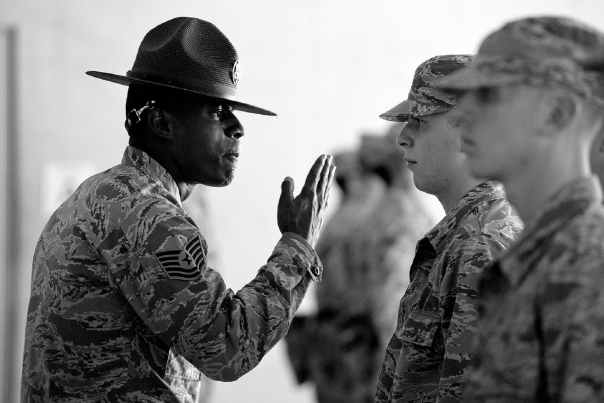
As a pastor, I love what Luther encourages (the purple quote) that the head of the household invest time in building up the faith of those in his care. Not only those who are his children, but those he works with, who are his “employees”. He does so, not by lecturing, but by questioning them, helping determine the places where they need to grow.
It is a different form of “teaching” a form that must be different, for what is being taught is different. It is not doctrine that is being taught, but faith. It is not data, but that we can trust and depend on Jesus, and on the Holy Spirit who is active in our lives. It is something that is experienced not just memorized, it is something that is shared with those we love, not just drilled into them.
It is what Isaiah refers to, the lessons of faith that enable us to see the Lord’s glory, which is actively giving strength to the tired hands, and the trembling weak knees, It is the life lived within the truth that discouragement is not conquered by determination and inner-strength, but rather in the fact that God has come to rescue us.
That is what the young nun realized, as she went to minister to those who were suffering. That is what the moms and dads, the employers, the teachers are called to “teach” by asking the questions that reveal the lack of knowledge of God’s presence and His work in our lives, for that is what is revealed in word and sacraments. It is that work, that love that causes us to trust, to depend on, to have faith in God.
Is this what we teach? Is it what we work and guide people in developing? Is it what those we count as mentors and pastors, teachers and “fathers” in the faith give to us? Will we/they walk alongside those (including us) understanding the broken, for we have seen God work in our brokenness?
Will at the end of the day, and at the end of life, they know they can depend on God, for they know His presence?
If they do, then we have taught them well…
Lord Jesus, help us to teach those who are part of our “homes”, the people who are family by blood, and those who are just family. Help us stimulate their trust in You, asking them the questions that help them find themselves in Your presence, and rejoice in Your caring work in their lives. AMEN!
Luther, M. (2007). Luther’s Spirituality. (P. D. W. Krey, B. McGinn, & P. D. S. Krey, Eds., P. D. S. Krey & P. D. W. Krey, Trans.) (pp. 189–190). New York; Mahwah, NJ: Paulist Press.
Joseph MC. (2012). From Adoration to Serving the Poor. In A. Reid (Ed.), From Eucharistic Adoration to Evangelization (p. 185). London; New York: Burns & Oates.
